
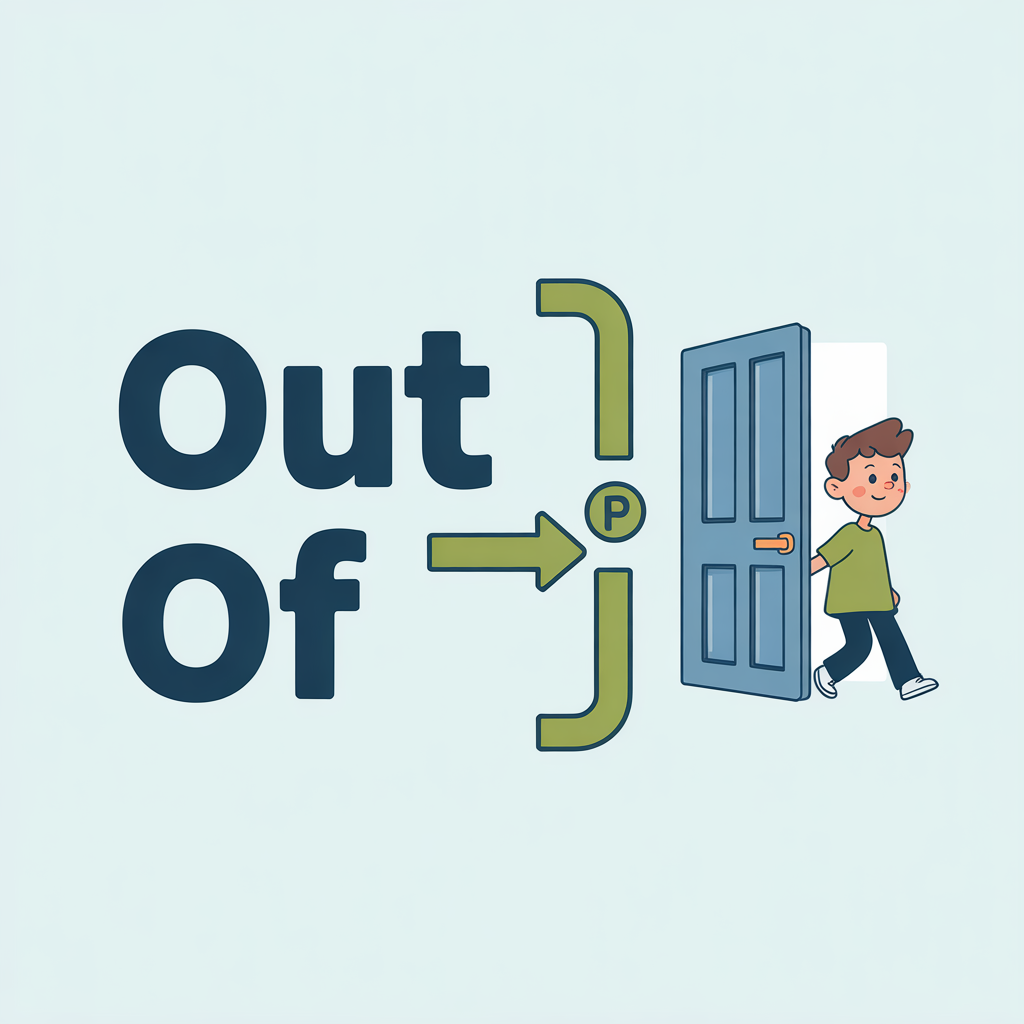
If you’ve ever said someone jumped out of a car or walked up to a door, you’ve already used a double preposition — you just might not have known it had a name. Double prepositions are one of those grammar features that native English speakers use constantly without thinking twice, yet they can puzzle learners and curious minds alike. This guide breaks down exactly what double prepositions are, why they exist, how they’re formed, and how to use them naturally and correctly.
What Are Double Prepositions?
A double preposition (also called a complex preposition or compound preposition) is a preposition made up of two smaller prepositions joined together to function as a single unit. Instead of using just one preposition, two are combined to create a more specific or nuanced meaning.
For example:
- Out of = out + of
- Up to = up + to
- On to = on + to
- From behind = from + behind
- Down to = down + to
Each pair of words works together as a single prepositional unit, showing the relationship between a noun, pronoun, or phrase and the rest of the sentence. The key feature is that neither word alone would convey the same precise meaning as the two words used together.
Why Do Double Prepositions Exist?
English has a rich system of spatial and logical relationships, and sometimes a single preposition simply isn’t precise enough to capture them. Double prepositions fill in these gaps by combining directional or relational words to give a fuller picture of movement, position, or relationship.
Think of the difference between:
- She walked out the door. (acceptable, but less descriptive)
- She walked out of the door. (more specific about direction and separation)
Out of tells us not only that she left, but also that she was previously inside and has moved away from that enclosed space. The extra preposition adds a layer of meaning that one word can’t fully deliver on its own.
Historically, English borrowed and evolved its prepositional system from Germanic, Latin, and French influences, which naturally led to overlapping and combining patterns. Double prepositions became a stable part of everyday usage over centuries of linguistic development.
How Are Double Prepositions Formed?
Double prepositions are typically formed by pairing:
- A directional adverb or particle (like out, up, down, from, off) with
- A simple preposition (like of, to, at, by, with)
The result is a two-word phrase that behaves grammatically like a single preposition. It takes an object (a noun or pronoun) after it, just as any regular preposition would.
Structure:
[Directional word] + [simple preposition] + [object]
Examples:
- He jumped out of [the pool].
- She climbed up to [the top].
- The cat leaped from behind [the curtain].
Common Double Prepositions in English
Here is a comprehensive look at the most frequently used double prepositions, along with their meanings and example sentences:
Out of
Meaning: Movement from the inside to the outside of something; also used to express source, reason, or exhaustion of supply.
- He ran out of the building when the alarm sounded.
- We’re out of milk — can you pick some up?
- She did it out of kindness, not obligation.
Out of is arguably the most versatile double preposition in English, covering physical movement, motivation, and depletion.
Up to
Meaning: As far as; moving toward a higher point or limit; responsibility or decision resting with someone.
- The water rose up to my knees.
- It’s up to you to decide what happens next.
- Children up to the age of 12 get in for free.
On to / Onto
Meaning: Movement toward and onto a surface; continuation from one point to the next. Note: onto (one word) and on to (two words) are both acceptable but have slightly different uses.
- The cat jumped onto the counter.
- Let’s move on to the next topic.
From behind
Meaning: Something emerging or acting from a rear or hidden position.
- A car appeared from behind the truck.
- He grabbed her from behind, startling her.
Down to
Meaning: Reaching a lower limit; being the responsibility of; attributable to.
- We’re down to our last few dollars.
- Their success was down to hard work and preparation.
From among
Meaning: Selected or coming from within a group.
- She was chosen from among hundreds of applicants.
From within
Meaning: Originating from the inside of something.
- The problem came from within the organization itself.
Out from
Meaning: Movement outward and away from a specific point.
- He stepped out from the shadows.
Up from
Meaning: Movement upward, starting from a specified point or level.
- Profits are up from last quarter.
Over to
Meaning: Across and toward a destination; handing something to someone else.
- He walked over to her desk.
- I’ll hand it over to the legal team.
Double Prepositions vs. Phrasal Verbs: What’s the Difference?
This is one of the most common points of confusion, and it’s worth clarifying clearly.
- A phrasal verb combines a verb with a particle (which looks like a preposition) to create a new verb meaning. The particle is attached to the verb. Example: to give up, to run out, to look forward to.
- A double preposition operates independently of the verb. It connects the verb’s action to an object by showing spatial or logical relationships.
Compare these two sentences:
- He ran out. (phrasal verb — “ran out” means exhausted something)
- He ran out of the building. (double preposition — “out of” shows direction from inside to outside)
The test: if you can remove the prepositional phrase and the sentence still makes grammatical and logical sense with the verb unchanged in meaning, you’re likely dealing with a double preposition, not a phrasal verb.
Double Prepositions vs. Prepositional Phrases
A prepositional phrase is any phrase that begins with a preposition and ends with its object. A double preposition is simply the beginning of a prepositional phrase — it’s the preposition itself, which happens to be made of two words.
So in the phrase “out of the box,” the prepositional phrase is the full unit (out of the box), and the double preposition is just out of.
Double Prepositions vs. Compound Prepositions: Are They the Same?
The terms are sometimes used interchangeably, but there is a subtle distinction worth knowing:
- Double prepositions: specifically refer to two-preposition combinations (e.g., out of, up to, from behind).
- Compound prepositions: a broader category that includes multi-word prepositions involving nouns, adjectives, or adverbs, not just two prepositions. Examples: in front of, on behalf of, in spite of, next to, because of.
All double prepositions can be considered compound prepositions, but not all compound prepositions are double prepositions.
Rules and Tips for Using Double Prepositions Correctly
1. Always Follow a Double Preposition with an Object
Like all prepositions, double prepositions must be followed by a noun, pronoun, or noun phrase (called the object of the preposition). They cannot stand alone at the end of a sentence in formal writing.
- ✅ She stepped out of the room.
- ❌ She stepped out of. (incomplete — needs an object)
2. Don’t Confuse “Out of” with Just “Out”
In American English, it is increasingly common to hear “He got out the car” instead of “He got out of the car.” However, “out of” remains the standard and preferred form in both formal writing and British English. Using just “out” as a preposition can sound informal or dialectal.
3. “Onto” vs. “On to” — Know When to Use Each
- Use onto (one word) when describing physical movement onto a surface: She climbed onto the roof.
- Use on to (two words) when on belongs to the verb and to introduces the next element: Hold on to the railing. / Move on to the next question.
A simple trick: if you can replace “onto” with “on top of” and the sentence still makes sense, use onto. If not, use on to.
4. Avoid Redundancy
Sometimes writers accidentally use a double preposition where only one preposition is needed, creating redundancy.
- ❌ Where are you going to? / Where are you going to at? — “to at” is a meaningless double.
- ✅ Where are you going?
Make sure each word in your double preposition is genuinely contributing to the meaning.
5. Context Determines Meaning
Many double prepositions carry multiple meanings depending on context. Out of, for instance, can signal movement, origin, motivation, or depletion. Always consider the surrounding sentence to ensure the right meaning comes across.
Double Prepositions in Formal vs. Informal English
Double prepositions appear freely in both formal and informal registers of English. They are not slang or colloquial — they are standard grammatical constructions. However, their frequency and which specific double preposition is used can vary:
- Formal/written English tends to be more precise and may prefer fuller forms: “emerging from within the department” rather than just “coming from inside it.”
- Informal/spoken English often uses double prepositions at a rapid pace and may blend them with contractions or drop words: “I’m outta here” (a casual reduction of “out of”).
The good news is that learning and using standard double prepositions like out of, up to, from behind, and down to will serve you well across virtually all contexts.
Double Prepositions in Other Languages: A Brief Comparison
Double prepositions are not unique to English. They appear in other languages too, though the way they are structured can differ:
- Italian: uses combinations like da dietro (from behind) and fin dentro (right inside).
- German: while German prepositions are often single words, combinations like von hinter (from behind) occur in spoken language.
- Spanish: uses phrases like desde dentro de (from within) which combine multiple relational words.
The human need to describe precise spatial and logical relationships drives the formation of double prepositions across different languages — it’s a universal linguistic phenomenon, not an English quirk.
Examples of Double Prepositions in Real Sentences
Here’s a broader set of natural sentences to illustrate double prepositions across a range of contexts:
- The puppy crawled out from under the bed.
- They watched the sunrise from behind the mountains.
- Temperatures dropped down to freezing overnight.
- I’ve been waiting here up until now, but no one came.
- The deal is worth anywhere from between one and five million dollars.
- He peeked out from behind the door.
- It’s entirely up to the committee to approve the budget.
- She inherited the company from out of nowhere — no one saw it coming.
Notice how these double prepositions make the spatial or logical relationships crystal clear. Removing or replacing one of the two words would leave the sentence vague or grammatically incomplete.
Common Mistakes Learners Make with Double Prepositions
Mistake 1: Using Only One Preposition When Two Are Needed
- ❌ She jumped out the window. (informal/dialectal)
- ✅ She jumped out of the window.
Mistake 2: Adding an Unnecessary Preposition
- ❌ Where did you come out from out of?
- ✅ Where did you come out of?
Mistake 3: Mixing Up “Into” and “In to”
- ❌ She logged into the website. / She came in to get a glass of water. (confusing the two)
- ✅ She logged into the website. (movement toward + entering)
- ✅ She came in to get a glass of water. (came in [verb particle] + to [purpose])
Mistake 4: Treating a Double Preposition as a Phrasal Verb
Learners sometimes think the first word is part of the verb. Remember: in “She ran out of ideas,” out of is a double preposition attached to ideas, not part of the verb “ran.”
Quick Reference: Most Used Double Prepositions at a Glance
| Double Preposition | Core Meaning | Quick Example |
|---|---|---|
| Out of | Movement from inside; source; depletion | He walked out of the room. |
| Up to | As far as; responsibility | It’s up to her to decide. |
| Down to | Reaching a lower limit; attributed to | Success is down to effort. |
| From behind | Origin from a rear position | He appeared from behind the tree. |
| Out from | Outward movement from a point | She stepped out from the crowd. |
| On to / Onto | Movement onto a surface; continuation | He jumped onto the platform. |
| From among | Selected from a group | One was chosen from among many. |
| Up from | An increase from a starting point | Sales are up from last year. |
| Over to | Across toward; handing over | Pass it over to me. |
| From within | Originating from the inside | Change must come from within. |
Conclusion
Double prepositions are a natural, elegant, and frequently used feature of English grammar. By combining two simple prepositions into one unit, they allow speakers and writers to express precise spatial, directional, and logical relationships that a single preposition cannot fully capture. Whether you’re describing movement (out of, from behind), establishing limits (up to, down to), or indicating origin (from within, from among), double prepositions are indispensable tools in your language toolkit.
The best way to master them is not by memorizing a list, but by noticing them in real reading and listening and gradually incorporating them into your own writing and speech. With consistent exposure, their usage will start to feel completely intuitive — just as it does for native speakers who use them every single day without a second thought.
Frequently Asked Questions (FAQs)
Are double prepositions always made of exactly two words?
Yes, by definition, a double preposition consists of exactly two prepositional words used together. If three or more words are involved (e.g., in front of, on behalf of), the structure is typically called a complex preposition or multi-word preposition rather than a double preposition.
Is “out of” one word or two?
Out of is always written as two separate words. It is never written as one word (outof). However, in casual spoken English you might hear it reduced to “outta” in informal contexts, which is not used in standard writing.
Can a sentence have more than one double preposition?
Technically yes, though it’s uncommon and can make a sentence feel awkward. For example: “He crawled out from under the bed and onto the floor.” Here, out from under (a triple preposition combination!) and onto both appear. Such stacking of prepositions is more common in descriptive or narrative writing.
Are double prepositions used in American and British English differently?
Mostly no — double prepositions like out of, up to, and from behind are standard in both varieties. One notable difference: American English more commonly drops the of in phrases like “out of the window” (American speakers sometimes say “out the window”), while British English almost always retains the full double preposition.
Do double prepositions change the tense or meaning of a verb?
No. Double prepositions are prepositional, not verbal. They describe relationships (position, direction, source) rather than modifying the verb’s tense or meaning. The verb’s tense is determined by its own conjugation, completely independently of any preposition that follows.