
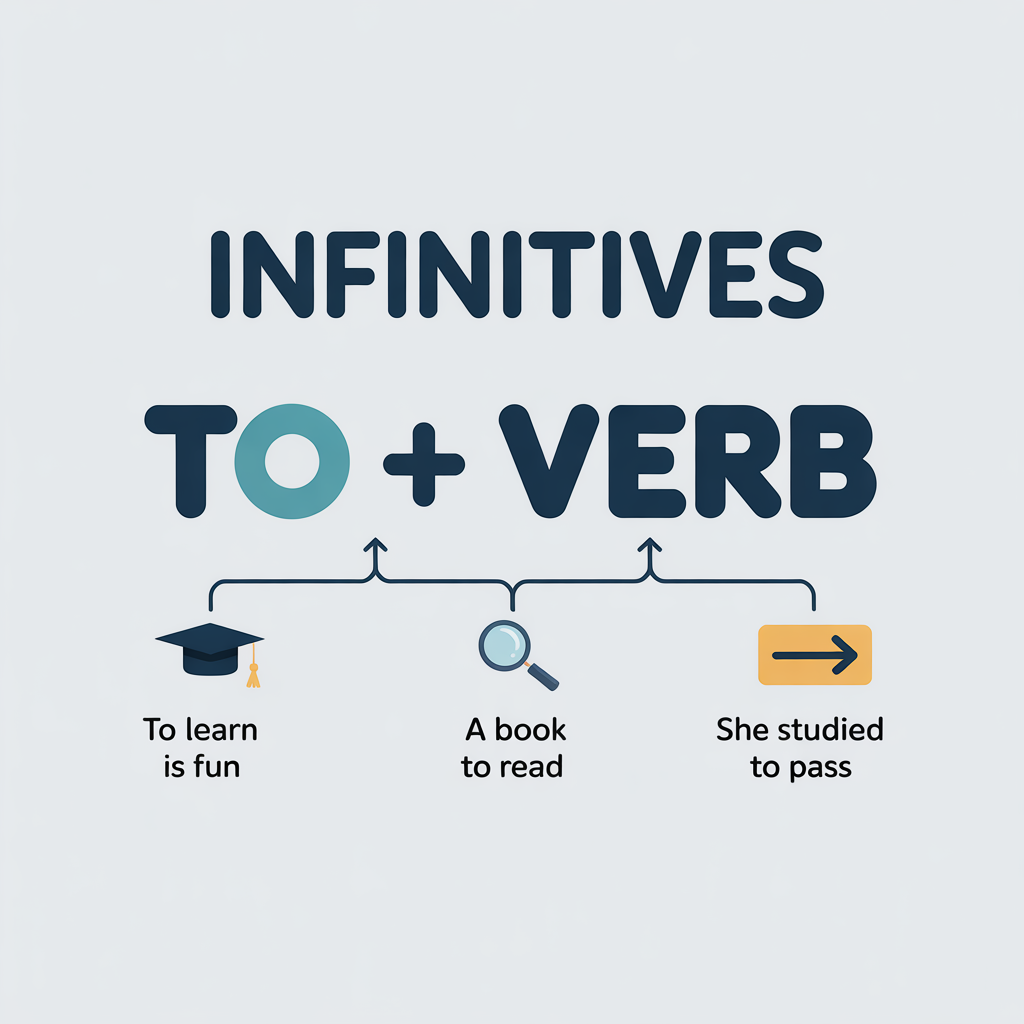
If you’ve ever stumbled across the phrase “to go,” “to learn,” or “to be” in a grammar lesson and wondered what makes them special, you’ve already encountered an infinitive. Infinitives are one of the most fundamental building blocks of English grammar — yet they’re also one of the most misunderstood. Whether you’re a student trying to master English, a writer aiming for precision, or simply a curious mind, understanding infinitives will sharpen your language skills in ways you might not expect. This guide breaks down everything you need to know: what an infinitive is, how it functions, the different types, and the common mistakes people make when using them.
What Is an Infinitive? The Basic Definition
An infinitive is the base form of a verb — the most fundamental version of a verb before it is conjugated or changed to reflect tense, person, or number. In English, the infinitive most commonly appears with the word “to” placed in front of it.
Think of it this way: the verb “run” in its base form is simply run. When you add “to” in front — to run — you get the infinitive.
Some quick examples:
- to eat — the infinitive of “eat”
- to think — the infinitive of “think”
- to be — the infinitive of “be”
- to understand — the infinitive of “understand”
The word “to” in this context is called an infinitive marker. It signals that the verb following it is in its base, non-finite form — meaning it isn’t bound to a specific subject or tense the way regular verbs are.
This is an important distinction. Unlike a finite verb (e.g., “she runs,” “they thought“), an infinitive is non-finite. It doesn’t change based on who is doing the action or when the action takes place.
The Two Types of Infinitives
Grammarians recognize two main forms of the infinitive in English. Understanding both helps you recognize them in the wild and use them correctly in your own writing and speech.
1. The Full Infinitive (To-Infinitive)
This is the most common form. It consists of “to” + the base verb.
- She wants to travel the world.
- He decided to quit his job.
- They agreed to meet at noon.
The to-infinitive is incredibly versatile. As you’ll see below, it can play many different grammatical roles in a sentence — acting as a noun, an adjective, or an adverb.
2. The Bare Infinitive (Zero Infinitive)
The bare infinitive is simply the base verb used without the word “to.” It appears in specific grammatical contexts where “to” is dropped.
- She helped him carry the boxes. (not “to carry”)
- I heard the birds sing. (not “to sing”)
- Let me explain. (not “to explain”)
The bare infinitive is required after:
- Modal verbs (can, could, will, would, shall, should, may, might, must): “You must rest.” / “She can dance.”
- Perception verbs (see, hear, feel, watch, notice) in active constructions: “I watched him leave.”
- Causative verbs (let, make, have): “They made us wait.”
- The expressions “had better,” “would rather,” and “would sooner”: “You’d better hurry.”
How Does an Infinitive Function in a Sentence?
One of the most fascinating things about infinitives is their grammatical flexibility. Unlike regular verbs, an infinitive can serve multiple roles within a single sentence. This is what linguists sometimes call its “nominal” or “verbal noun” quality — it straddles the line between a verb and other parts of speech.
Infinitive as a Noun (Subject or Object)
An infinitive can act as a noun, functioning as the subject or object of a sentence.
As a subject:
- To forgive is divine.
- To learn a new language takes time.
As an object:
- She loves to read.
- He forgot to call.
Infinitive as an Adjective
An infinitive can modify a noun, just like an adjective does. It typically comes after the noun it describes.
- She has a report to write. (modifies “report”)
- This is the best book to read this summer. (modifies “book”)
- He needs something to drink. (modifies “something”)
Infinitive as an Adverb
An infinitive can also modify a verb, adjective, or another adverb, functioning like an adverb — often expressing purpose, cause, or result.
Expressing purpose (= in order to):
- She went to the library to study.
- He woke up early to catch the train.
Expressing cause (after adjectives):
- I’m happy to help.
- She was shocked to hear the news.
Expressing result:
- He lived to see his grandchildren.
- She grew up to become a doctor.
The Infinitive Phrase: Going Beyond the Single Word
In most real sentences, an infinitive doesn’t appear alone. It forms an infinitive phrase — a group of words built around the infinitive that includes any objects, complements, or modifiers connected to it.
For example:
- She wants to become a professional photographer.
- He tried to finish the project before the deadline.
- Our goal is to build a more sustainable community.
In each case, the infinitive phrase acts as a unit. The entire phrase, not just the infinitive, performs the grammatical function (noun, adjective, or adverb) within the sentence.
The Split Infinitive: A Rule Worth Knowing
You may have heard a rule that says you should never split an infinitive. A split infinitive occurs when a word — usually an adverb — is placed between “to” and the base verb.
The most famous split infinitive in pop culture? “To boldly go where no man has gone before” — from Star Trek. Here, “boldly” splits the infinitive “to go.”
Traditionally, some grammarians considered split infinitives poor style, influenced partly by Latin grammar (where splitting is impossible since the infinitive is one word, like amare meaning “to love”). However, modern linguists and most style guides accept split infinitives when they improve clarity or flow.
Compare:
- “She decided to completely renovate the house.” (split — natural and clear)
- “She decided completely to renovate the house.” (unsplit — slightly awkward)
- “She decided to renovate completely the house.” (unsplit — changes the meaning slightly)
The bottom line: use your judgment. If splitting the infinitive makes the sentence clearer and more natural, it’s perfectly acceptable in contemporary English.
The Perfect, Continuous, and Passive Infinitive Forms
Beyond the simple infinitive, English has several other infinitive constructions that express different time relationships and voices. These are more advanced but important to understand for reading complex texts.
The Perfect Infinitive
Structure: to have + past participle
This form expresses an action that was completed before the action of the main verb.
- He seems to have forgotten our meeting. (He forgot it before now.)
- She claims to have seen the accident.
The Continuous Infinitive
Structure: to be + present participle (-ing)
This expresses an ongoing action happening at the same time as the main verb.
- He pretends to be working, but he’s actually scrolling social media.
- She appeared to be struggling with the question.
The Perfect Continuous Infinitive
Structure: to have been + present participle (-ing)
This combines both the perfect and continuous aspects.
- He must to have been waiting for hours.
- She seems to have been crying.
The Passive Infinitive
Structure: to be + past participle
This form is used when the subject receives the action rather than performing it.
- The report needs to be submitted by Friday.
- He wants to be recognized for his efforts.
Common Verbs Followed by the To-Infinitive
One of the most practical things to memorize is which verbs typically take the to-infinitive (as opposed to the gerund — the -ing form). Here are some of the most common:
- Verbs of desire or wish: want, wish, hope, desire, would like
- Verbs of decision or intention: decide, plan, intend, choose, prepare
- Verbs of attempt or effort: try, attempt, manage, fail
- Verbs of promise or offer: promise, offer, agree, refuse
- Verbs of learning or teaching: learn, teach, train
- Verbs of expectation: expect, hope, seem, appear
Examples:
- She decided to leave early.
- He promised to call.
- They managed to escape.
- I hope to see you soon.
Infinitive vs. Gerund: When to Use Which
A common point of confusion for English learners is knowing when to use an infinitive (to + verb) versus a gerund (verb + -ing). Both can function as nouns, but the choice often depends on the preceding verb — and sometimes changes the meaning entirely.
Some verbs take only the infinitive:
- She wants to go. ✅ / She wants going. ❌
- He agreed to help. ✅ / He agreed helping. ❌
Some verbs take only the gerund:
- She enjoys swimming. ✅ / She enjoys to swim. ❌
- He avoids eating sugar. ✅ / He avoids to eat sugar. ❌
Some verbs take both, with a difference in meaning:
This is where it gets especially interesting. A handful of verbs — notably remember, forget, stop, try, regret — change meaning depending on whether they’re followed by an infinitive or a gerund.
- I remember to lock the door. (I remember, so I do it — future action.)
- I remember locking the door. (I recall doing it — past action.)
- She stopped to smoke. (She paused her activity in order to smoke.)
- She stopped smoking. (She quit the habit of smoking.)
- He tried to fix the car. (He made an effort to fix it.)
- He tried fixing the car. (He experimented with fixing it as a solution.)
Common Mistakes to Avoid with Infinitives
Even fluent English speakers sometimes slip up with infinitives. Here are the most frequent errors and how to avoid them.
Mistake 1: Using an infinitive after a preposition
After a preposition (in, on, at, before, after, without, etc.), always use the gerund, not the infinitive.
- ❌ She’s interested in to learn photography.
- ✅ She’s interested in learning photography.
Exception: The phrase “in order to” is a prepositional phrase specifically designed to introduce an infinitive.
Mistake 2: Using a to-infinitive after modal verbs
Modal verbs (can, must, should, will, may, etc.) always take the bare infinitive.
- ❌ You must to finish this today.
- ✅ You must finish this today.
Mistake 3: Confusing perception verb constructions
After verbs like see, hear, watch, feel in active sentences, use the bare infinitive or -ing, not the to-infinitive.
- ❌ I saw her to leave.
- ✅ I saw her leave. / I saw her leaving.
Mistake 4: Double “to”
This happens when people add “to” after verbs that already imply direction.
- ❌ Where do you want to go to? (redundant)
- ✅ Where do you want to go?
Why Understanding Infinitives Matters
You might wonder — why does any of this matter? The answer is both practical and profound.
First, on a practical level, understanding infinitives helps you construct grammatically correct sentences, avoid common errors, and communicate with precision. For non-native speakers, mastering the infinitive vs. gerund distinction alone dramatically improves writing quality.
Second, on a deeper linguistic level, infinitives reveal something beautiful about language itself. They sit at the intersection of verbs and nouns, action and abstraction. “To dream” is both something you do and something you can talk about — an action crystallized into a concept.
In writing, infinitives are particularly powerful for expressing purpose, goal, and aspiration. Consider how differently these phrases feel:
- “She worked hard.” — a simple statement.
- “She worked hard to build something meaningful.” — a statement with direction, purpose, and emotional depth.
That’s the power of the infinitive.
Quick Reference: Infinitive Rules at a Glance
| Situation | Form to Use | Example |
|---|---|---|
| After modal verbs | Bare infinitive | She can sing. |
| After “to” (standard) | To-infinitive | He wants to learn. |
| After make/let/have | Bare infinitive | Let him speak. |
| After prepositions | Gerund (-ing) | Before leaving… |
| Expressing purpose | To-infinitive | She studies to improve. |
| Modifying a noun | To-infinitive | Work to do |
Conclusion
An infinitive is the base form of a verb — most often appearing as to + verb, or occasionally as a bare verb without “to.” What makes it remarkable is its versatility: the same little phrase can act as a noun, an adjective, or an adverb depending on context. It can express goals, describe nouns, communicate completed past actions, and suggest ongoing ones — all depending on its form and placement.
Whether you’re studying grammar formally, refining your writing, or trying to master English as a second language, the infinitive is a concept worth truly understanding — not just memorizing rules around. Once you see how it works, you’ll start noticing it everywhere: in literature, in conversation, in headlines, in poetry. And your own sentences will become richer and more precise for it.
To learn is to grow — and now you have one more powerful tool in your grammatical toolkit.
Frequently Asked Questions (FAQs)
What is the difference between an infinitive and a gerund?
Both can function as nouns in a sentence, but they are formed differently. An infinitive uses to + base verb (e.g., to swim), while a gerund uses the -ing form of the verb (e.g., swimming). Certain verbs only take one or the other, and some verbs (like remember, stop, and try) take both but with different meanings.
Is “to” always part of an infinitive?
No. The bare infinitive (also called the zero infinitive) is the base verb used without “to.” It appears after modal verbs (can, must, should), causative verbs (make, let, have), and some perception verbs (see, hear, watch).
Can an infinitive be the subject of a sentence?
Yes! When an infinitive or infinitive phrase functions as the subject, it acts like a noun. Example: “To succeed requires discipline.” However, in everyday speech, it’s more common to use a dummy subject like “It” instead: “It requires discipline to succeed.”
Is it grammatically wrong to split an infinitive?
No — not by modern standards. While traditional grammar discouraged split infinitives (placing an adverb between “to” and the verb), contemporary grammarians and major style guides generally accept them when they improve clarity or naturalness. Use your judgment based on the context.
What is a perfect infinitive?
A perfect infinitive uses the structure to have + past participle and refers to an action completed before the action of the main verb. Example: “She seems to have left already.”
Why are infinitives called “non-finite” verbs?
A finite verb is one that is conjugated — it changes to reflect subject, tense, or number (e.g., “she runs,” “they ran“). An infinitive is non-finite because it doesn’t change in these ways. “To run” stays the same regardless of whether the subject is “I,” “she,” or “they,” and it carries no tense on its own.