
Every sentence you speak, write, or read is built on a foundation of nouns. They name the people you love, the places you visit, the ideas you hold, and the things you interact with every day. Yet, despite being the most common word class in the English language, many people struggle to explain exactly what a noun is — or why it matters. This guide breaks it all down: what a noun is, the different types that exist, how they function in a sentence, and why understanding them makes you a sharper communicator.
What Is a Noun? The Core Definition
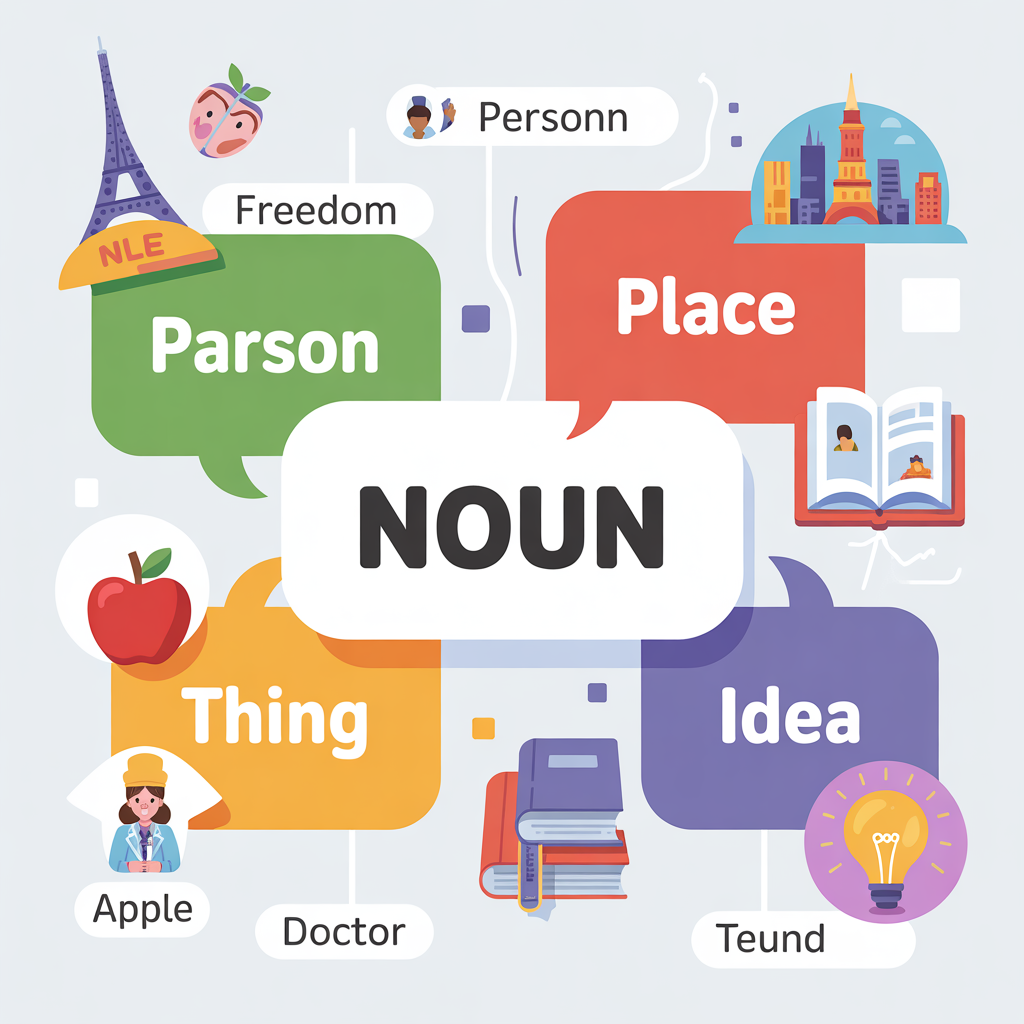
A noun is a word that identifies or names a person, place, thing, or idea. It is one of the eight traditional parts of speech in English grammar and is arguably the most fundamental building block of any sentence.
The simplest way to think about a noun is this: if you can point to it, name it, or think about it as a concept, it’s likely a noun. Consider these examples:
- Person: teacher, Maria, doctor, child
- Place: city, Paris, kitchen, ocean
- Thing: book, car, computer, apple
- Idea: freedom, happiness, justice, love
Nouns can appear almost anywhere in a sentence — as the subject performing an action, as the object receiving one, or as part of a descriptive phrase. Their versatility is precisely what makes them so essential.
Why Are Nouns Important in Grammar?
Understanding nouns is not just an academic exercise. It has real, practical benefits for reading, writing, and communication.
- Clarity: Precise nouns eliminate vagueness. Saying “the golden retriever” is far more vivid than simply saying “the animal.”
- Sentence structure: Every complete sentence needs a subject — and subjects are almost always nouns or pronouns standing in for nouns.
- Agreement: Nouns determine whether verbs and pronouns should be singular or plural, which is essential for grammatical correctness.
- Vocabulary growth: Recognising noun patterns (like the suffixes -tion, -ness, -ment) helps you decode and learn new words faster.
The Many Types of Nouns
Nouns are not a single, monolithic category. English grammar recognises several distinct types, each with its own characteristics and rules. Let’s explore each one.
1. Common Nouns
A common noun is a general name for a person, place, or thing. It does not refer to a specific individual or unique entity, so it is not capitalised (unless it begins a sentence).
- Examples: dog, river, mountain, woman, city, phone
Common nouns are the workhorses of everyday language. When you say “I saw a dog in the park,” both dog and park are common nouns.
2. Proper Nouns
A proper noun names a specific, unique person, place, organisation, or thing. Proper nouns are always capitalised, regardless of where they appear in a sentence.
- Examples: Eiffel Tower, Amazon, Australia, Taylor Swift, Monday, Google
The key distinction: river is a common noun, but the Amazon River is a proper noun because it names one specific river.
3. Abstract Nouns
An abstract noun refers to ideas, emotions, qualities, or concepts — things you cannot physically see, touch, hear, smell, or taste. They exist in the mind and in human experience.
- Examples: courage, democracy, grief, knowledge, trust, beauty, time
Abstract nouns are particularly important in academic writing, philosophy, and emotional expression. When you say “She showed incredible resilience,” resilience is an abstract noun.
4. Concrete Nouns
The opposite of abstract nouns, concrete nouns refer to physical things you can perceive with one or more of your five senses.
- Examples: rain, coffee, guitar, hand, smoke, bread
If you can experience it physically, it’s likely a concrete noun. Most nouns that children learn first are concrete — mama, ball, juice, dog — because they correspond to tangible, observable things.
5. Countable Nouns
A countable noun (also called a count noun) refers to things that can be counted individually. They have both singular and plural forms.
- Singular: a cat, one chair, an apple
- Plural: three cats, several chairs, many apples
Countable nouns can be preceded by articles (a, an, the) and numbers, making them relatively easy to identify.
6. Uncountable Nouns
An uncountable noun (also called a mass noun or non-count noun) refers to substances, concepts, or categories that cannot be counted as individual units. They do not have a standard plural form.
- Examples: water, air, information, furniture, rice, advice, music
You wouldn’t say “three informations” or “an advice.” Instead, you’d say “three pieces of information” or “a piece of advice.” This is one of the trickiest areas for non-native English speakers.
7. Collective Nouns
A collective noun refers to a group of people, animals, or things as a single unit.
- Examples: team, flock, committee, family, audience, herd, jury
Collective nouns can be singular or plural depending on context and dialect. In American English, collective nouns are usually treated as singular: “The team is ready.” In British English, they are often treated as plural: “The team are ready.”
Some collective nouns are wonderfully specific and colourful — a murder of crows, a pride of lions, a parliament of owls.
8. Compound Nouns
A compound noun is formed by combining two or more words to create a single noun with a new, unified meaning. They can be written as one word, hyphenated, or as two separate words.
- One word: toothpaste, sunflower, bedroom, notebook
- Hyphenated: mother-in-law, self-esteem, check-in
- Two words: ice cream, post office, high school
The meaning of a compound noun is often different from the meanings of its individual parts. A blackbird, for instance, is not just any black bird — it refers to a specific species.
9. Possessive Nouns
A possessive noun shows ownership or a relationship between two things. It is formed by adding an apostrophe and an s (‘s) to a noun, or just an apostrophe (‘) after a plural noun ending in s.
- The dog’s collar (singular possessive)
- The students’ project (plural possessive)
- James’s car (singular proper noun ending in s)
How Do Nouns Function in a Sentence?
Nouns are extraordinarily versatile. They can play multiple grammatical roles within a sentence. Understanding these roles takes your grammar knowledge from basic to advanced.
As the Subject
The subject is the noun that performs the action of the verb.
- The scientist published a groundbreaking study.
As the Direct Object
The direct object receives the action of the verb directly.
- She painted a portrait.
As the Indirect Object
The indirect object identifies to whom or for whom the action is done.
- He gave his sister a gift.
As the Object of a Preposition
Nouns follow prepositions to form prepositional phrases.
- The keys are on the table.
As a Subject Complement (Predicate Nominative)
After linking verbs like is, was, become, seem, a noun can rename or describe the subject.
- She became a doctor.
As an Appositive
An appositive is a noun placed next to another noun to identify or rename it.
- My friend, an architect, designed this building.
How to Identify a Noun in a Sentence
Not always sure if a word is a noun? Here are a few reliable techniques:
- The article test: If you can place a, an, or the in front of a word and it makes sense, it’s likely a noun. (a dog, an idea, the freedom)
- The plural test: If the word can be made plural, it’s probably a countable noun. (one book → many books)
- The suffix clue: Many nouns end in recognisable suffixes:
- -tion / -sion: education, decision
- -ness: happiness, darkness
- -ment: government, achievement
- -ity: creativity, simplicity
- -ance / -ence: performance, patience
- -er / -or: teacher, actor
- -ism / -ist: capitalism, journalist
- Ask “What?” or “Who?”: Find the verb in the sentence and ask “who?” or “what?” The answer is your noun.
Nouns vs. Other Parts of Speech
English is full of words that can act as more than one part of speech depending on how they are used. This is called functional shift or conversion.
- I need a drink. (noun)
- Let’s drink some water. (verb)
- She has a beautiful mind. (adjective modifying the noun mind)
- Her beauty is undeniable. (noun)
Context is everything. The same word can shift its role depending on its position and function in a sentence.
Noun Phrases: When Nouns Team Up
A noun phrase is a group of words that functions as a noun in a sentence. It includes the noun itself along with any modifiers — articles, adjectives, prepositional phrases — that describe it.
- The tall, old oak tree at the end of our street fell last night.
Here, the tall, old oak tree at the end of our street is the noun phrase. The head noun is tree, and everything else modifies it. Noun phrases allow for richer, more detailed description without requiring additional sentences.
Common Mistakes People Make with Nouns
Even experienced writers stumble over nouns from time to time. Here are the most frequent errors and how to avoid them:
- Misusing uncountable nouns: Saying “I need some informations” instead of “I need some information.” Remember that uncountable nouns don’t take a plural form.
- Apostrophe errors: Confusing it’s (it is) with its (possessive). The possessive form of it does not use an apostrophe.
- Capitalising common nouns: Writing “I went to the Park” when park is not a proper noun here. Only proper nouns need capitalisation.
- Incorrect plurals: Irregular plurals like child → children, mouse → mice, and criterion → criteria catch many people off guard.
- Overusing abstract nouns: Heavy reliance on abstract nouns (especially in business writing) can make sentences vague. “We achieved a realisation of improvement” is weaker than “We improved.”
Nouns Across Different Contexts
The way nouns are used varies depending on the type of writing or communication:
- Academic writing: Tends to rely heavily on abstract nouns and nominalisations (turning verbs into nouns, e.g., discuss → discussion).
- Creative writing: Favours concrete, sensory nouns that paint vivid pictures.
- Business communication: Benefits from specific, precise nouns that reduce ambiguity.
- Everyday speech: Uses a mix of all noun types, often with informal collective language.
Conclusion
Nouns are the anchors of language. They name our world — every person we know, every place we visit, every idea we explore, and every object we use. Understanding what a noun is goes far beyond memorising a textbook definition. It means recognising the eight key types of nouns, knowing how each functions in a sentence, and using them deliberately to communicate with clarity and precision.
Whether you are learning English as a second language, helping a child with homework, brushing up on grammar for professional writing, or simply satisfying your curiosity, mastering nouns is one of the most rewarding steps you can take. Every great piece of writing — every powerful speech, every compelling story — is built, noun by noun, into something meaningful.
Frequently Asked Questions (FAQs)
What is a noun in simple terms?
A noun is a word that names a person, place, thing, or idea. Examples include teacher, London, chair, and happiness.
What are the 8 types of nouns?
The eight main types of nouns are: common nouns, proper nouns, abstract nouns, concrete nouns, countable nouns, uncountable nouns, collective nouns, and compound nouns. Possessive nouns are sometimes listed as an additional type.
Can a word be both a noun and a verb?
Yes. Many English words can function as both a noun and a verb depending on context. For example, run is a verb in “I run every morning” but a noun in “She went for a run.”
What is the difference between a common noun and a proper noun?
A common noun names a general category (e.g., city, river, dog), while a proper noun names a specific, unique entity and is always capitalised (e.g., New York, the Nile, Labrador).
What is a noun phrase?
A noun phrase is a group of words centred around a noun that functions as a single noun in a sentence. For example, in “The old red bicycle in the garage belongs to me,” the noun phrase is the old red bicycle in the garage.
Is “love” a noun?
Yes, love can be a noun — specifically an abstract noun. For example: “Love is a powerful emotion.” It can also function as a verb: “I love hiking.” Context determines its role.
What is the difference between abstract and concrete nouns?
Concrete nouns refer to physical things you can perceive with your senses (e.g., coffee, stone, thunder), while abstract nouns refer to intangible concepts, emotions, or ideas (e.g., justice, fear, ambition).