
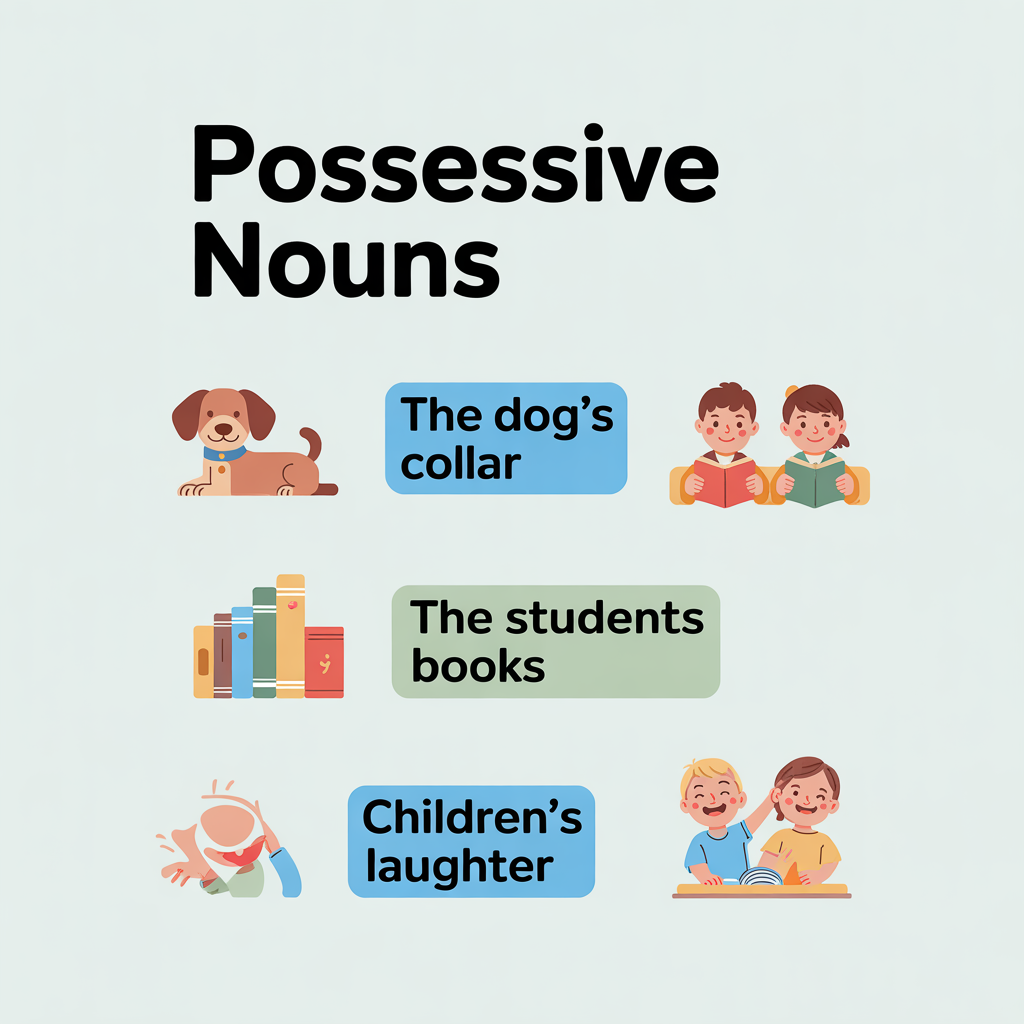
Every time you write Maria’s book or the team’s victory, you are using a possessive noun — one of the most practical tools in the English language. Yet despite how often we use them, possessive nouns trip up writers at every level. Where exactly does the apostrophe go? What happens with plural nouns? What about names that end in s? This guide answers all of those questions clearly and completely, so you can use possessive nouns with total confidence.
What Is a Possessive Noun?
A possessive noun is a noun that has been modified to show ownership, belonging, or a close relationship between one thing and another. In English, possessive nouns are almost always formed by adding an apostrophe — the punctuation mark that looks like a raised comma (‘) — along with the letter s.
Think of a possessive noun as a compact way of expressing a relationship that would otherwise require several words. Instead of saying the collar that belongs to the dog, you simply say the dog’s collar. The possessive form does the heavy lifting for you.
Possessive nouns answer the question “Whose?” or “Of what?” For example:
- Whose laptop is this? → Sarah’s laptop.
- The roof of which building? → The building’s roof.
It is worth noting that possessive nouns are different from possessive pronouns (like his, hers, its, theirs). Possessive pronouns never use an apostrophe. Possessive nouns almost always do.
Why Do Possessive Nouns Matter?
You might wonder whether it is really worth spending time on this topic. The short answer is yes — for several reasons.
- Clarity: Without the correct possessive form, sentences can become ambiguous or confusing. The students exam leaves the reader guessing. The student’s exam or the students’ exam makes the meaning clear immediately.
- Professionalism: Misplaced apostrophes stand out in professional writing — in emails, reports, and articles. Getting it right signals that you pay attention to detail.
- Grammar accuracy: Standardized tests, job applications, and academic writing all assess correct apostrophe usage. Mastering this rule has real, practical value.
How to Form Possessive Nouns: The Core Rules
The rules for forming possessive nouns depend on three main factors: whether the noun is singular or plural, and whether a plural noun already ends in s. Let’s break each case down clearly.
Rule 1: Singular Nouns — Add ‘S
For any singular noun (a noun referring to one person, place, thing, or idea), add an apostrophe followed by the letter s.
- the cat → the cat’s whiskers
- the doctor → the doctor’s office
- the company → the company’s headquarters
- a child → a child’s imagination
This rule applies even when the singular noun already ends in the letter s. This is where many writers hesitate — but the standard grammatical rule in most style guides is still to add ‘s.
- James → James’s guitar
- the boss → the boss’s decision
- Charles Dickens → Charles Dickens’s novels
Note on style variation: Some style guides — particularly in journalism — allow you to use just an apostrophe after singular nouns ending in s (e.g., Dickens’ novels). The most important thing is to choose one style and stay consistent throughout your writing.
Rule 2: Regular Plural Nouns — Add Apostrophe Only
Most plural nouns in English already end in s (e.g., dogs, teachers, countries). For these, you add only an apostrophe after the existing s — no additional s is needed.
- the dogs → the dogs’ food bowls
- the teachers → the teachers’ lounge
- the students → the students’ projects
- the countries → the countries’ economies
This is where the classic confusion between singular and plural possessives becomes critical. Consider the difference:
- The student’s assignment = one student has an assignment.
- The students’ assignment = multiple students share an assignment.
The meaning changes entirely based on where the apostrophe sits.
Rule 3: Irregular Plural Nouns — Add ‘S
Some English nouns form their plural in an irregular way — they do not simply add an s at the end. Words like children, men, women, mice, and teeth are examples. Because these plurals do not end in s, you treat them like singular nouns and add ‘s.
- children → children’s toys
- men → men’s clothing
- women → women’s rights
- mice → mice’s habitat
- geese → geese’s feathers
A Quick Reference Summary
| Type of Noun | How to Form Possessive | Example |
|---|---|---|
| Singular (not ending in s) | Add ‘s | the dog’s tail |
| Singular (ending in s) | Add ‘s (or just ‘) | James’s car / James’ car |
| Regular plural (ending in s) | Add ‘ only | the players’ uniforms |
| Irregular plural (not ending in s) | Add ‘s | the children’s school |
Possessive Nouns vs. Plural Nouns: Don’t Confuse Them
One of the most widespread errors in English writing involves mixing up a simple plural noun with a possessive noun. A plural noun just means “more than one.” A possessive noun shows ownership. An apostrophe is never used to make a noun plural.
Here are some examples of this common mistake — and the correction:
- Wrong: She bought three apple’s from the market.
Right: She bought three apples from the market. (plural, no apostrophe needed) - Wrong: The dog’s are playing outside.
Right: The dogs are playing outside. (plural, no apostrophe needed) - Wrong: All the student’s passed the test.
Right: All the students passed the test. (plural subject, no possession involved)
Ask yourself: Am I expressing that something belongs to a noun? If yes, use an apostrophe. If you are simply saying there is more than one of something, do not use an apostrophe.
Joint vs. Separate Possession
When two or more nouns share possession of the same thing, this is called joint possession. When they each own separate things, it is called separate possession. The placement of the apostrophe changes depending on which situation you mean.
Joint Possession
Add ‘s to only the last noun in the list.
- Luke and Emma’s apartment → They share one apartment.
- Tom and Jerry’s friendship → They share one friendship.
Separate Possession
Add ‘s to each noun in the list.
- Luke’s and Emma’s apartments → They each have their own apartment.
- Hannah’s and Noah’s cars → Each person has their own car.
Possessive Nouns for Inanimate Objects
A question that often comes up: Can inanimate objects (things, not people or animals) be made possessive? Technically, yes — but there is some nuance here.
In everyday modern English, it is perfectly acceptable and common to use possessive forms for inanimate objects:
- the city’s skyline
- the book’s cover
- the car’s engine
- the contract’s terms
However, in more formal or traditional writing, it is often preferred to use an of-phrase for inanimate objects:
- the skyline of the city
- the cover of the book
- the engine of the car
Both forms are grammatically correct. Your choice may depend on the tone and formality of your writing.
Possessive Nouns in Time and Measurement Expressions
A slightly overlooked use of possessive nouns involves expressions of time and value. These are called temporal possessives or measure possessives, and they follow the same apostrophe rules.
- a day’s work (the work of one day)
- two weeks’ vacation (a vacation of two weeks)
- a year’s experience (experience of one year)
- five dollars’ worth (worth of five dollars)
Notice that day’s is singular possessive (one day), while weeks’ is plural possessive (more than one week).
Common Mistakes with Possessive Nouns (And How to Fix Them)
Even experienced writers make mistakes with possessive nouns. Here are the most common pitfalls to watch out for:
Mistake 1: Confusing “its” and “it’s”
This is arguably the most famous apostrophe error in English. Remember:
- Its (no apostrophe) = possessive pronoun meaning “belonging to it.” Example: The company lost its best client.
- It’s (with apostrophe) = contraction of “it is” or “it has.” Example: It’s a beautiful day.
Trick: If you can replace it with “it is” and the sentence still makes sense, use it’s. If not, use its.
Mistake 2: Adding ‘s to Plural Nouns That Already End in S
- Wrong: The boy’s’s school — (nonsensical)
- Wrong: The boys’s school
- Right: The boys’ school
Mistake 3: Omitting the Apostrophe Entirely
- Wrong: I borrowed Michaels pen.
- Right: I borrowed Michael’s pen.
Mistake 4: Putting the Apostrophe in the Wrong Place
- Wrong: The ladys’ handbag (implies multiple ladies)
- Right: The lady’s handbag (one lady)
Mistake 5: Using Apostrophes for Decade References
Decades are plural, not possessive.
- Wrong: The 1980’s were exciting. (unless referring to something from the 1980s)
- Right: The 1980s were exciting.
Possessive Nouns vs. Possessive Adjectives vs. Possessive Pronouns
It helps to understand how possessive nouns fit into the broader category of possessives in English.
- Possessive noun: A noun form showing ownership. Requires an apostrophe. Example: the teacher’s book.
- Possessive adjective (also called possessive determiner): Words like my, your, his, her, its, our, their. They modify a noun and show who it belongs to. No apostrophe. Example: her book.
- Possessive pronoun: Words like mine, yours, his, hers, ours, theirs. They stand alone and replace a noun. No apostrophe. Example: The book is hers.
Only possessive nouns use apostrophes. This distinction is fundamental and worth memorizing.
Real-World Examples of Possessive Nouns in Context
Seeing possessive nouns in full sentences makes the rules more concrete. Here is a variety of examples across different contexts:
- The president’s speech was broadcast live across the nation.
- We adopted one of the shelter’s oldest cats.
- The athletes’ performances exceeded all expectations.
- Have you read any of Shakespeare’s sonnets?
- The museum’s new exhibit opened to great reviews.
- The children’s laughter echoed through the park.
- She took a week’s leave to care for her family.
- Both Anna’s and Ben’s ideas were presented to the board.
- Mars’s surface is covered in red dust. (singular noun ending in s)
Tips for Remembering Possessive Noun Rules
If you find yourself second-guessing the apostrophe, these quick mental checks can help:
- Ask “Whose?” or “Of what?” — If the answer involves a noun, that noun likely needs to be possessive.
- Write the noun first, then add the apostrophe. Write dogs first, then add the apostrophe after: dogs’. This prevents you from placing the apostrophe too early.
- Check if it’s plural or singular before adding the apostrophe. Singular? Add ‘s. Regular plural already ending in s? Add only ‘. Irregular plural not ending in s? Add ‘s.
- Read it aloud. Your ear can often catch what your eye misses. “The boys’ basketball team” sounds right; “the boy’s basketball team” for a team of boys sounds wrong.
Conclusion
A possessive noun is simply a noun that shows ownership or a close relationship with another noun, formed by adding an apostrophe and, in most cases, the letter s. The rules are logical and learnable: singular nouns take ‘s, regular plurals ending in s take only an apostrophe, and irregular plurals take ‘s again.
Once you understand these core rules — and learn to avoid classic pitfalls like using apostrophes for plural nouns or confusing its with it’s — possessive nouns become second nature. They are one of the most useful structures in English for expressing relationships concisely and clearly.
Keep this guide bookmarked for reference, practice with real sentences, and you will find yourself writing possessive nouns confidently and correctly in no time.
Frequently Asked Questions About Possessive Nouns
What is the difference between a possessive noun and a plural noun?
A plural noun simply refers to more than one of something and does not require an apostrophe (e.g., cats, books). A possessive noun shows ownership or a relationship and requires an apostrophe (e.g., the cat’s toy, the book’s cover). Never use an apostrophe just to make a noun plural.
Do proper nouns follow the same possessive rules?
Yes. Proper nouns — names of specific people, places, or things — follow the same rules. Emily’s car, London’s streets, and Tesla’s innovation are all correct. For names ending in s, most style guides recommend adding ‘s (e.g., James’s), though some allow just an apostrophe (James’).
Can you have a possessive noun without something following it?
Yes. Sometimes the possessed object is implied and omitted to avoid repetition. Example: I borrowed Maya’s jacket, not Sarah’s. Here, “jacket” is understood from context, and “Sarah’s” stands alone as a possessive noun.
Is “children’s” correct? It doesn’t end in s before the apostrophe.
Yes, children’s is completely correct. Because children is an irregular plural that does not end in s, it follows the same rule as singular nouns: add ‘s. Other examples include men’s, women’s, and geese’s.
What about compound nouns? How do you make them possessive?
For compound nouns (nouns made of more than one word), add the possessive ending to the last word. Example: my mother-in-law’s recipe, the attorney general’s decision, the editor in chief’s column.
Is “the dog’s” always singular? Could it ever be plural?
In the sentence “the dog’s bone,” yes — it refers to one dog. If there were multiple dogs, you would write “the dogs’ bone.” The position of the apostrophe is the only visual signal of this important difference, which is why getting it right matters so much.