
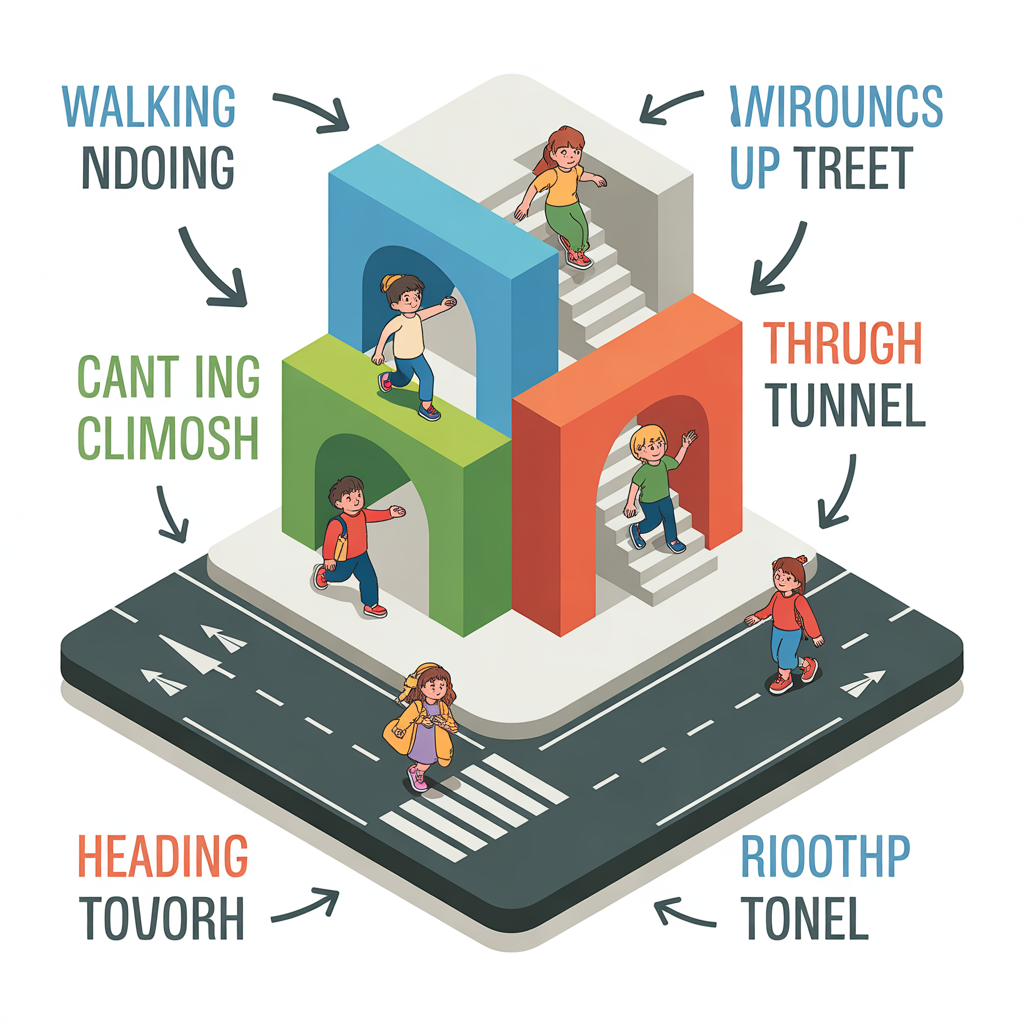
If you’ve ever given someone directions — “Turn left at the corner” or “Walk into the building” — you’ve already used prepositions of direction without even thinking about it. These small but mighty words are the backbone of how we describe movement in English. Yet for many learners, they remain confusing, especially when similar-looking prepositions seem interchangeable but aren’t. This guide breaks down everything you need to know about prepositions of direction: what they are, how they work, which ones to use when, and how to avoid the most common mistakes.
What Are Prepositions of Direction?
A preposition of direction is a word (or short phrase) that indicates the direction of movement or the path taken from one point to another. Unlike prepositions of place, which describe where something is (static), prepositions of direction describe where something or someone is going or moving (dynamic).
They almost always appear alongside a verb of movement — words like go, run, walk, drive, fly, move, come, jump, fall, and similar action verbs.
Quick comparison:
- Preposition of place (static): The cat is on the table. (Where the cat is)
- Preposition of direction (dynamic): The cat jumped onto the table. (Where the cat moved)
The difference may seem subtle, but it fundamentally changes the meaning of the sentence. Mastering this distinction is a key step in developing fluent, natural-sounding English.
Why Are Prepositions of Direction Important?
Prepositions of direction serve several critical functions in everyday communication:
- They clarify movement: Without them, a sentence like “She walked the park” makes little sense. Was she walking around it, through it, toward it, or into it? The preposition answers that question.
- They show relationships between people and places: They describe the relationship between the subject performing an action and the destination or path involved.
- They prevent misunderstanding: Choosing the wrong preposition — for example, “He jumped in the pool” versus “He jumped into the pool” — can shift meaning or sound unnatural to native speakers.
- They are essential for giving and following directions: Real-world tasks like navigating a city, following instructions, or reading a map all depend on a solid grasp of directional prepositions.
A Full List of Common Prepositions of Direction
Let’s explore the most important prepositions of direction in English, with clear definitions and example sentences for each.
1. To
“To” is the most fundamental preposition of direction. It points toward a destination — a specific endpoint of movement. It signals that the subject is heading somewhere definite.
- She is going to the supermarket.
- He drove to work every morning.
- We walked to the end of the street.
Key note: “To” implies arrival or a clear goal. It pairs with verbs like go, come, return, travel, move, walk, drive, fly, head.
2. Into
“Into” describes movement from outside to inside a space or container. It emphasizes entering or transitioning to an enclosed area.
- She walked into the room.
- The child jumped into the swimming pool.
- He poured the juice into the glass.
Common confusion — “in” vs. “into”:
- She is in the room. (Location — she is already there)
- She walked into the room. (Direction — she moved from outside to inside)
3. Onto
“Onto” describes movement from one surface to another — typically upward or forward onto a surface.
- The dog jumped onto the couch.
- She climbed onto the roof.
- He loaded the boxes onto the truck.
Common confusion — “on” vs. “onto”:
- The keys are on the table. (Location)
- She placed the keys onto the table. (Direction — movement to the surface)
4. Toward / Towards
“Toward” (American English) and “towards” (British English) indicate movement in the direction of something, but not necessarily reaching it. The destination is approximate or uncertain.
- She walked toward the door but stopped halfway.
- The dog ran towards the children.
- He turned toward the sound.
Key distinction — “to” vs. “toward”:
- She drove to the hospital. (She arrived.)
- She drove toward the hospital. (She was heading that way — but may not have arrived.)
5. From
“From” indicates the starting point or origin of movement. It is the opposite of “to.”
- He traveled from London to Paris.
- She ran from the house to the garden.
- The letter came from an old friend.
6. Through
“Through” describes movement from one side of a space to the other, passing within it. Think of it as moving inside something and coming out the other end.
- We drove through the tunnel.
- The hikers walked through the forest.
- Water flows through the pipes.
7. Across
“Across” describes movement from one side of a surface or open space to the other. It is typically used for flat, wide areas like roads, rivers, or fields.
- She swam across the river.
- The children ran across the playground.
- He walked across the street.
Through vs. Across:
- Use “through” when you move inside something (a tunnel, a forest, a crowd).
- Use “across” when you move over the surface of something (a field, a river, a road).
8. Along
“Along” describes movement following a line or path — like a road, a river bank, or a path. The movement is parallel to something.
- We walked along the beach.
- She cycled along the river path.
- Drive along this road for two miles.
9. Up and Down
“Up” and “down” indicate direction on a vertical axis — upward or downward movement.
- She climbed up the stairs.
- The ball rolled down the hill.
- He walked up the mountain trail.
They can also be used for slopes or inclines even without a strictly vertical movement:
- Drive up the hill and turn left.
- She skied down the slope at high speed.
10. Around
“Around” describes circular movement or movement that encircles something.
- The Earth moves around the Sun.
- We walked around the lake.
- The runners jogged around the track.
11. Over and Under
“Over” describes movement above and across something, while “under” describes movement below something.
- The plane flew over the mountains.
- She climbed over the fence.
- The submarine moved under the bridge.
- The cat crawled under the bed.
12. Past
“Past” describes movement that goes beyond a point without stopping — passing by.
- Walk past the bakery and turn right.
- The bus drove past my stop without stopping.
- She ran past him without noticing.
13. Away from
“Away from” is a prepositional phrase indicating movement in the opposite direction of something — moving farther from a point.
- The cat ran away from the dog.
- She moved away from the noisy crowd.
- He drove away from the city.
Prepositions of Direction vs. Prepositions of Place — Side-by-Side Comparison
One of the trickiest parts of learning prepositions is understanding how the same-looking word can function differently depending on context. Here’s a quick reference table:
| Preposition | Place (Static) | Direction (Dynamic) |
|---|---|---|
| In / Into | The book is in the bag. | She put the book into the bag. |
| On / Onto | The phone is on the desk. | He set the phone onto the desk. |
| Over / Above | The lamp hangs above the table. | The bird flew over the lake. |
| Under / Below | The dog is under the chair. | The fish swam under the bridge. |
| By / Past | She lives by the river. | He walked past the shop. |
How to Use Prepositions of Direction in Sentences
Using prepositions of direction correctly requires attention to three things:
1. Pair Them With Movement Verbs
Prepositions of direction work hand-in-hand with verbs that imply motion. If your verb describes a static state (like be, sit, remain, stay), you likely need a preposition of place instead.
- ✅ She ran into the building. (movement verb + direction preposition)
- ❌ She is into the building. (static verb — use “in” instead)
2. Consider the Type of Movement
Ask yourself:
- Is there a specific endpoint? → Use to
- Is something moving inside something else? → Use into
- Is something moving onto a surface? → Use onto
- Is something passing through? → Use through
- Is something moving in a general direction without necessarily arriving? → Use toward/towards
3. Combine Them Naturally
In natural speech, multiple directional prepositions may appear in one sentence:
- She walked from the car, through the gate, and into the house.
- He ran up the stairs and into his bedroom.
Common Mistakes With Prepositions of Direction (And How to Fix Them)
Mistake 1: Using “in” Instead of “into”
- ❌ She walked in the store.
- ✅ She walked into the store.
Fix: If you’re describing the act of entering, use “into.” “In” describes location, not movement.
Mistake 2: Using “on” Instead of “onto”
- ❌ The cat jumped on the counter. (acceptable but informal)
- ✅ The cat jumped onto the counter. (more precise for direction)
Mistake 3: Confusing “toward” and “to”
- ❌ She was walking to him but stopped when she saw his face.
- ✅ She was walking toward him but stopped when she saw his face.
Fix: If movement is interrupted or the destination is not reached, “toward” is more accurate.
Mistake 4: Using “through” When “across” Is Needed
- ❌ She swam through the lake. (sounds like she swam inside the lake — odd)
- ✅ She swam across the lake.
Prepositions of Direction in Everyday Contexts
Understanding how these prepositions work in real-world situations helps solidify your grasp of them.
Giving Directions
- “Walk along Main Street, go past the post office, and turn into Oak Avenue.”
- “Drive through the tunnel, then head toward the city center.”
Storytelling and Narrative
- “The hero sprinted across the bridge, leaped over a gap, and dove into the river below.”
Sports and Physical Activity
- “The player kicked the ball into the net.”
- “The cyclist rode up the steep hill and down the other side.”
Travel and Navigation
- “We flew from New York to London and then took a train through the countryside.”
A Quick-Reference Summary
- To — movement toward a definite destination
- From — movement away from a starting point
- Into — entering an enclosed space
- Onto — moving onto a surface
- Toward / Towards — movement in a direction without necessarily arriving
- Through — passing inside something from one side to another
- Across — moving over a flat surface from one side to the other
- Along — following a path or line
- Up / Down — vertical or inclined movement
- Around — circular movement
- Over / Under — movement above or below something
- Past — movement beyond a point without stopping
- Away from — movement in the opposite direction of something
Conclusion
Prepositions of direction are small words that carry enormous communicative weight. They tell your listener or reader exactly how movement is happening — whether someone is entering a space, passing through it, moving over it, heading toward it, or departing from it. Getting these right doesn’t just improve your grammar scores; it makes your English sound natural, confident, and precise.
The key takeaway is simple: always think about the type of movement happening. Is it entering? Into. Moving across a flat space? Across. Heading in a direction without necessarily arriving? Toward. Once you train yourself to ask that question, the right preposition will come to you naturally. Practice with real-life scenarios — give directions, write short stories, describe your commute — and these prepositions will quickly become second nature.
Frequently Asked Questions (FAQs)
What is the difference between prepositions of direction and prepositions of movement?
The terms are often used interchangeably, and in most grammar resources, they refer to the same category of prepositions. Some teachers use “prepositions of movement” as the broader category (which includes direction), while “prepositions of direction” specifically emphasize where something is heading. In practice, you’ll rarely need to distinguish between them.
Can a preposition be both a preposition of place and a preposition of direction?
Yes. Many prepositions, such as over, under, by, and behind, can function as either, depending on context. The determining factor is usually the verb in the sentence — a movement verb signals direction, while a stative verb signals place.
Is “toward” or “towards” correct?
Both are correct. “Toward” is preferred in American English, while “towards” is standard in British English. You can use either form consistently — just don’t mix them within the same piece of writing.
What are the most important prepositions of direction for beginners to learn first?
Start with the four most commonly used ones: to, into, onto, and from. Once you’re comfortable with these, expand to through, across, along, toward, and past. These eight will cover the vast majority of directional situations in everyday English.
Do prepositions of direction always require a movement verb?
In most cases, yes. Directional prepositions are typically paired with verbs of motion. However, in casual or compressed speech (such as road signs and instructions), the verb is sometimes implied rather than stated. For example, a sign reading “To the exit →” omits the verb but clearly communicates direction.